
The Story
The Paths
Mukti Kshetra is named in the Puranas, sung by the Alvars, walked by the rishis, and chosen by Nilkanth Varni for the fiercest tapasya of his van vicharan. Yet across two centuries, its name has slipped from the foreground of the bhaktas' memory. We exist to return it.
There is a ground at the edge of the Himalaya where Vishnu is held to be self-manifest: not consecrated, not installed, but present by his own will. It is one of only eight such svayam-vyakta kshetras in the whole of the Vaishnava canon, and the only one beyond the plains of Bharat. The river that flows past it carries the Shaligram, the one river on earth that does. The Alvars sang of this place twelve hundred years ago. The Sapt Rishis are said to have come to it. And in 1793, a twelve-year-old vanvasi named Nilkanth Varni stood here for four months in the most severe penance of his seven-year journey across Bharat-varsha.
This is Mukti Kshetra. Pulhashram. Muktinath. And for all its place in the scriptures, most of the Hindu world today cannot say where it is.
That is the gap we exist to close. Our sankalpa, the vow that holds this work, is to bring this maha tirtha back into the living memory of the bhaktas. We are not introducing something new. We are returning to the foreground what the tradition placed at its centre and time let slip.
We are the Chalise family, Nepali Hindus whose home ground is Muktinath itself. We are locals of the place, not pilgrims passing through it. The ground that the Swaminarayan sampraday and the broader Vaishnava canon hold as a maha tirtha is the ground on which our family has lived for generations.
This is the structural fact at the heart of our work. It would be rare for a scholar from within the sampraday to give three decades to Muktinath, as the tradition has many urgent calls on its scholarship closer to home. It would be rare for a guide from the plains to carry a lifelong, ground-level knowledge of a corridor in the high Himalaya. What we offer is exactly that: the scholarship of the place, held by people of the place.
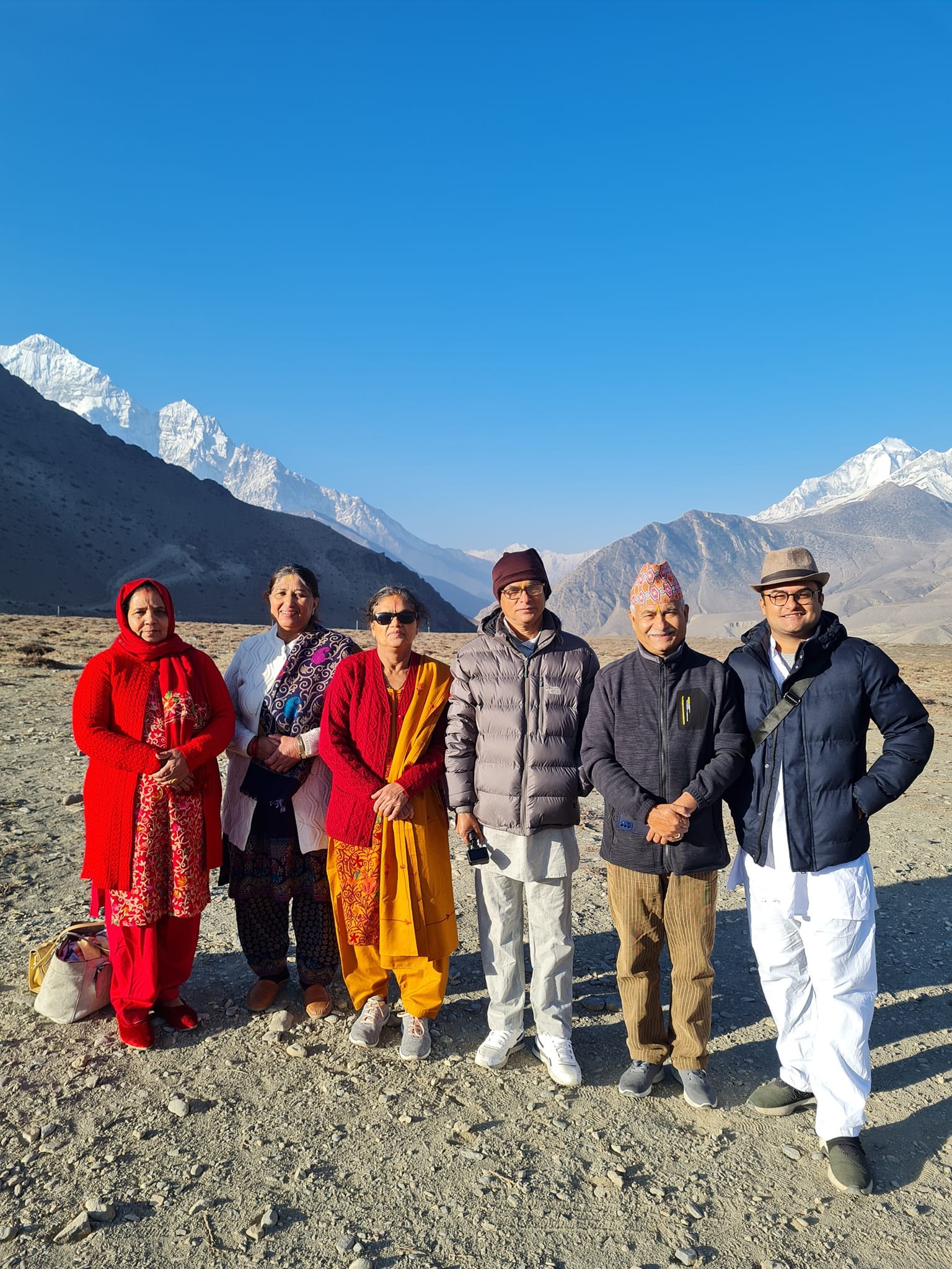
Dr. Kul Raj Chalise was born in the region of Muktinath. His scholarly work began in the 1990s and has continued, without interruption, for more than three decades. He has walked the Kali Gandaki corridor continuously, from Jomsom to Muktinath, from Galeshwor to Damodar Kunda, reading the Puranic references aloud at the grounds they describe, comparing the sites named in the Bhagavata and the Gandaki Mahatmya against the living geography, and documenting the sacred corridor with the patience of a lifetime.
His central argument, across the whole body of work, is the one this website rests on: the Kali Gandaki corridor is the most significant Vaishnava tirtha outside India, and its prominence in the Puranic canon is out of all proportion to the attention it receives in the modern Hindu world.
In early 2023, when ancient stones were taken from the Kali Gandaki region to Ayodhya, Dr. Chalise served on the committee of scholars on the Nepali side that reviewed and authenticated them, confirming their origin within the Kali Gandaki geological system and their significance under the shastra. The episode brought the most significant surge of global Hindu attention to this corridor in living memory. It is, in large part, the reason our work began now rather than a decade from now.
Read his full work and the account of the Ayodhya Dev Shila-s →
Dr. Chalise's son, Anup Raj Chalise, is the co-founder of our work and carries its public-facing and operational side. The partnership is deliberate. Dr. Chalise's scholarship is the source; Anup brings that scholarship into forms the wider community can engage with: articles, films, recordings, and the yatra itself. When a family arrives at Muktinath under Dr. Chalise's guidance, they are received by someone whose entire life and scholarship has been given to the ground they have come to see.
Gyan is the scholarship: writings, essays, and primary scripture, rooted in Dr. Chalise's decades of research. Katha is the telling, the transmission of that scholarship through film, recording, and narrative. Yatra is the pilgrimage itself, a small gathering led to Mukti Kshetra through the Kali Gandaki corridor. Three paths. One ground.